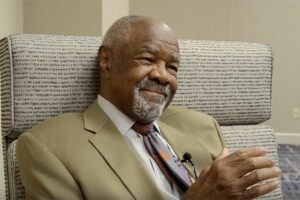
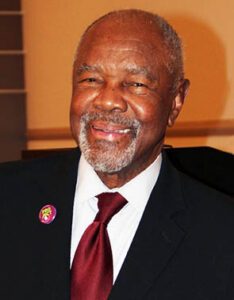
AOA Past President and Civil Rights Movement leader William G. Anderson, DO, passed away on Aug. 16, 2026, at the age of 98. In his 98 years, Dr. Anderson made an incredible impact on the history of the U.S. and was also instrumental in fostering the welcoming, supportive culture of the osteopathic medical profession.
“On behalf of the osteopathic medical profession, I wish to express my deepest condolences to Dr. Anderson’s loved ones,” said AOA President Richard R. Thacker, DO, MACOI. “Our profession is so very proud of Dr. Anderson and all that he accomplished in his incredible life, from spearheading the Albany Movement during the Civil Rights Movement to becoming an accomplished and respected surgeon. With his gripping autobiographies and the American Osteopathic Foundation scholarship fund he established, Dr. Anderson’s indelible mark on the osteopathic medical profession will live on for generations to come.”
From medicine to civil rights
Dr. Anderson was born in Americus, Georgia, in 1927. He was introduced to osteopathic medicine by a family friend, who was, at the time, the only Black osteopathic physician in the South. Like his family friend, Dr. Anderson attended Des Moines University College of Osteopathic Medicine in Iowa. After completing his training, he established a thriving family medicine practice in Albany, Georgia.
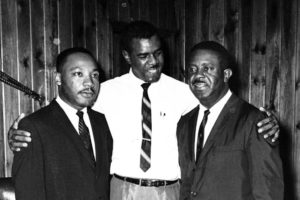
While in Albany, Dr. Anderson became motivated to protest for civil rights after seeing students march in support of voting rights for African Americans. He quickly became the organizer and leader of the Albany Movement, the first mass effort to protest community segregation in the Civil Rights era. Dr. Anderson’s leadership in the Albany Movement was supported by fellow Civil Rights Movement leaders Rev. Martin Luther King Jr., PhD, and Rev. Ralph David Abernathy.
Dr. Anderson (center) became the organizer and leader of the Albany Movement, working with with the Rev. Dr. King (left) and Rev. Abernathy (right) to protest segregation during the Civil Rights era.
“Throughout his life, Dr. Anderson never strayed from his values of compassion, citizenship, justice and fairness,” said AOA President-elect Bruce A. Wolf, DO. “He was not afraid to speak up, to march and protest, to try to create a better world for his children and his fellow citizens, a world where people of all races have equal access to resources and opportunities.
“He often said that if you do not leave this world in a better place than when you get here, who needed you? Well, we can honestly say the world needed Dr. Anderson, and he most certainly made the world a better place and made a difference!”
While the fight for racial equality throughout the U.S. continues today, Dr. Anderson’s actions during the Civil Rights Movement helped usher in an era where meaningful progress toward that ideal was achieved.
Breaking barriers
Following the Albany Movement, the situation for African Americans began to improve in Albany, particularly in the areas of education and politics, Dr. Anderson noted during an AOA staff forum in 2021. After the movement’s conclusion, Dr. Anderson moved to Michigan, where he became the first Black surgery resident in Detroit.
Following his residency, Dr. Anderson led a successful surgery practice in Michigan and also served his community and the osteopathic medical profession via a number of important roles, including as an associate clinical professor at the Michigan State University College of Osteopathic Medicine and an advisor to the Michigan Health Care Education and Research Foundation.
“Dr. Anderson has broken myriad barriers as an osteopathic physician, Civil Rights leader and educator,” said AOA Immediate Past President Robert G.G. Piccinini, DO, D.FACN. “He improved every institution, school and organization that he was involved in and left each significantly better than they had been before. His incredible life and work have served as a great inspiration to our entire profession that will never be forgotten.”
In 1994, Dr. Anderson became the AOA’s first Black president. He also served on the AOA Board of Trustees for two decades.
Dr. Anderson made history as the AOA’s first Black president, serving from 1994 to 1995. He was also a member of the AOA’s Board of Trustees for two decades and addressed the AOA House of Delegates in 2023. He has authored two autobiographies, one which he cowrote with his wife, Norma Lee Anderson, and published in 2004, and another which published in 2025.
“The osteopathic profession has lost an icon,” said AOA CEO Kathleen Creason. “With his long and storied history, Dr. Anderson had an immeasurable impact on the osteopathic medical profession and will be so missed by us all. We are so grateful for his hard work, encouragement and commitment to the profession and creating the change he believed in so passionately.”
Supporting the next generation
In 1998, Dr. Anderson took steps to create the William G. Anderson, DO, Scholarship Fund through the American Osteopathic Foundation (AOF) as part of his efforts to support minority osteopathic medical students who champion health equity. The first scholarship of $5,000 was awarded in 2001. The fund has grown over the years and has supported many students.
Through the scholarship fund, Dr. Anderson sought to foster a medical profession where individuals of many different backgrounds are welcomed and can thrive. Having been through many struggles in his journey to becoming a physician, he knew firsthand the impact that financial support and positive recognition can have on an individual.
“There are all kinds of ways to make positive change, and Dr. Anderson proved that day-to-day in his efforts to advance both the Civil Rights Movement and osteopathic medicine,” said Barbara Ross-Lee, DO, the first African American woman to be named dean of a U.S. medical school. “His tireless efforts, along with his kindness and respect to all, can inspire us all to embody his legacy in our medical care and beyond.”
This year, the AOF will be awarding up to 25 scholarships in the amount of $10,000 each to medical students who exemplify the scholarship’s purpose.
“Dr. Anderson’s indelible mark on the osteopathic medical profession will live on for generations to come,” said AOA President Richard R. Thacker, DO, MACOI.
‘His impact will be felt for years to come’
“To us at AOF, Dr. Anderson’s story transcends time and reminds us all how one act of kindness and generosity can create a lasting ripple of change,” said Rita Forden, AOF’s CEO. “His impact will be felt for years to come through the lives he touched and the opportunities he created. That impact is his legacy.”
In 2009, to show their appreciation for Dr. Anderson’s efforts, AOF awarded him with their Lifetime Achievement Award. Recipients are chosen carefully by the organization, with the goal of showcasing those who have had a lasting impact on the osteopathic medical profession and demonstrate a lifetime commitment to its principles and practice.
“While we have lost a champion, Dr. Anderson’s legacy of hard work, compassion and commitment to society and the osteopathic profession will resound indefinitely through generations of current and future physicians,” said Crystal Goree, DO, a 2019 recipient of the scholarship. “In the words of Isaac Newton, ‘If I have seen further, it is by standing on the shoulders of Giants.’ I am the human and physician that I am today because of Giants like Dr. William G. Anderson. Being a recipient of the scholarship held in his name came at a pivotal time of financial need in medical school that propagated the trajectory of my future.
“Today, I continue to be inspired to make a difference in my community by living and working in rural areas. Thank you, Dr. Anderson, for your kindness, persistence in fighting the good fight and for being a role model for the ages.”
Dr. Anderson and his wife, Norma, who is also deceased, had five children: A. Laurita Faison, William Anderson II, DO (Doris Anderson), Vale J. Henson, Frank L. Anderson, DO, and Darnita Anderson Hill, DO (Gary Hill). They had 10 grandchildren: Erika Henson, Shannon Anderson, Maxwell Faison, Camille Blake, DO, Barrett Anderson, DO, Brittany Anderson, Fatima Henson, Aliyah Hill, Amirah Hill, DO, and Mikail Hill. They had seven great-grandchildren: Iman Waiswa, Sydney Blake, Clinton Blake, Emery Blake, Xavier Williams, Charli Marceaux and Penelope Anderson.
We’re introducing a new way for you to log in to the AOA’s websites. If you haven't already established your new login credentials, here's how to get started:
Your username This is the email address associated with your AOA account.
Your password You'll begin setting this up by clicking “Forgot password?” on the login page.